

The "How To" of Utility Performance Management
Utility Performance Management is officially “off the ground,” with our materials and method available on our website, in our Impact Report, and around social media. But how do you DO utility performance management, particularly as a smaller or underresourced utility? For this month’s blog, we wanted to take our members through the inception of UPM and into the way we see the “how to” come through the UPM Workshop Series. This blog is adapted from a presentation Moonshot Missions CEO George Hawkins has made to our partners and stakeholders new to UPM. Please email preserve@moonshotmissions.org if you have questions about how to implement UPM in your own work!
UPM Origin
As George Hawkins describes in his Linkedin post, the impetus for UPM as an idea really began in budget meetings during Hawkins’s time with DC Water. As he describes it:
“Projects were sorted into priority categories — the top ones aimed at regulatory compliance and water quality absorbed nearly all the funding. One category rarely got funded: "BBP." It turned out to stand for "Better Business Practices" — projects meant to help the utility run more efficiently”.
It was a lightbulb moment for Hawkins and DC Water CFO Mark Kim. The next year they started requiring that every project include a BBP evaluation. It reframed the utility's mindset: efficiency projects often cost more upfront, but they pay off long-term. Once DC Water started actively seeking them out, the direction of the utility shifted. Once the team saw the savings, they couldn’t keep up with the projects coming in!
When Hawkins then began to develop Moonshot Missions and the Moonshot Missions method, a big part of the origin was to find projects that help improve the balance sheet. By changing the system, the system started delivering these projects.
Moonshot then began to center their work implementing UPM around the following two questions:
How do we take all of these ideas and turn it into a system that generates these kinds of projects?
How do we scale this concept to much smaller places? Essentially, what is the “UPM package?”
This has led Moonshot Missions to develop UPM and begin to roll it out to utilities in the Great Lakes region.
Utility Performance Management
Hawkins offers up an important metaphor for the current state of technical assistance by comparing it to emergency medicine. While emergency medicine is COMPLETELY necessary, it often doesn’t treat the underlying causes of patients in the emergency room. A utility performance management mindset allows us to find projects that address those underlying causes, not just the emergency triage.
That shift in thinking is the foundation of a new management approach for utilities: one that creates a feedback loop, letting communities invest in themselves without defaulting to a rate increase.
The Flywheel
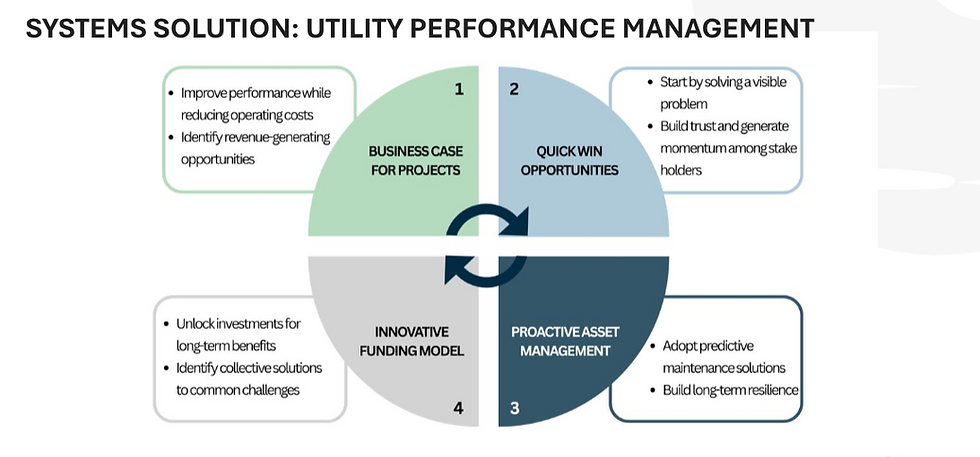
Big shifts need careful scaffolding. Moonshot illustrates this with a flywheel: projects that carry upfront costs but generate real, compounding returns over time — reinvested savings fund the next round of improvement, and so on.
The UPM Workshop Series
As a means of operationalizing the UPM mindset shift, the Moonshot Missions launched a UPM Workshop Series. The series is meant to offer you all the opportunity to operationalize the UPM model and achieve measurable results within your existing resources, resulting in a Utility Performance Management Certificate. Through 6 interactive virtual workshops, practical tools, case studies, and peer learning, we hope to help you develop business cases, capital project lists, and a 12-month action roadmap, in addition to two in-person Adaptive Leadership sessions that help turn these plans into action.
The first session allowed us to lay the foundation for UPM and begin thinking about “fires” that need to put out regularly. The second session, developing a business case, helped participants dive deeper into these fires and how we can transform them into adaptive challenges, a conversation will continue at our in person meetings in October. After an in person session on adaptive leadership, the facilitation will continue with asset management, innovative funding, and a session on governance. Each of these sessions offer speakers, case studies and, most importantly, dedicated and interactive time to allow participants to apply this work back to their own utilities.
The Bottom Line
Without closing the gap between revenue and cost, deeper technical assistance won't be enough on its own. Larger utilities can often absorb the cost of change; Moonshot's focus is making sure smaller utilities can too. Moonshot has built a team that knows both what to do and how to do it, and we are so excited to pilot this initiative with you!
For more details, please check out this brochure and corresponding event link. And please direct all questions to preserve@moonshotmissions.org!


Comments